Jump to content
  • entries
    32
  • comments
    100
  • views
    2,638

Court-Card Competence


Barleywine

296 views

AUTHOR’S NOTE: Conventional wisdom regarding the level of competence exhibited by the members of the tarot court is that the Kings have mastered their element while the Pages are utterly inexperienced, with the Knights and Queens falling somewhere in the middle.


The progression is assumed to be linear, but I just came across the idea that the Pages are blissfully ignorant and may not appreciate the risks, the Knights are worse off because they know just enough to be dangerous to themselves and others, the Queens are gradually recovering from that deficiency and the Kings have plateaued at a sustainable level. (This was described as the Dunning-Kruger Effect, a confidence-vs-competence curve.)


I’ve always viewed it as a straight-line progression rather than an undulating slope, but it did give me pause to think about it and develop a slightly different model. As I see it, each aspirant is closing in on the next level of mastery but has not quite reached it, so the situation is a work-in-progress.


Paraphrasing the old knowledge-vs-ignorance quotient, we could say that the Pages don’t have a clue how much there is to learn and may be overconfident; the Knights understand that they don’t know everything and therefore aren’t likely to overstep their bounds; the Queens are in a position to mentor the Knights while still topping off their own expertise; and the Kings are comfortable in their proficiency while constantly embracing further education.


Note that, as always, no gender-specificity should be assumed in the cards of the example below.
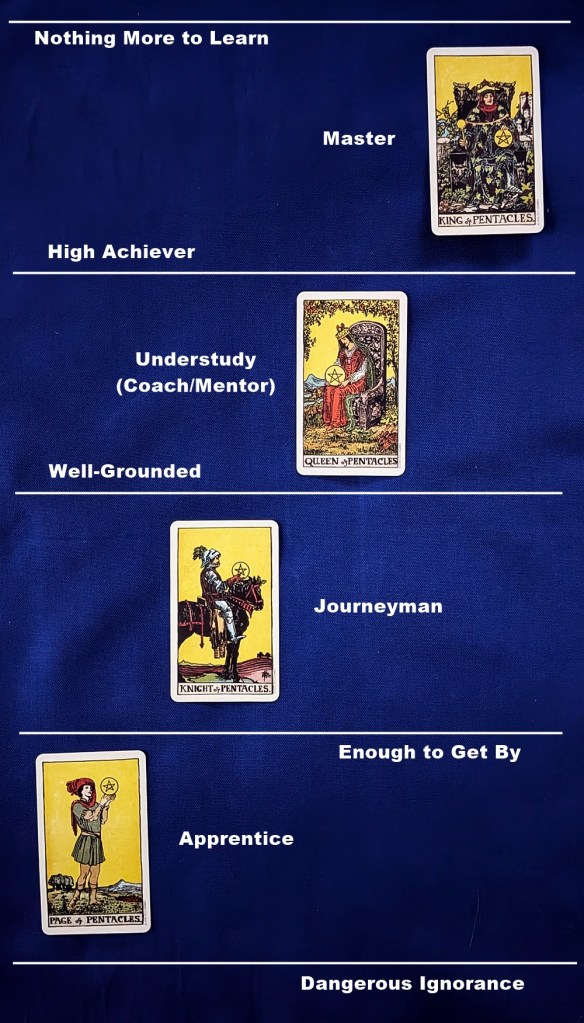
 

pxl_20250908_104353476.jpg?w=584 Waite-Smith Centennial Edition, copyright of US Games Systems Inc, Stamford, CT

10 Comments


Recommended Comments

Chariot

Posted

I think this approach works, but maybe needs to be expanded a bit.  I use all of these you mention, to some extent.  However, Pages also represent communications related to the suit, Knights represent actions related to the suit, Queens represent nurturing related to the suit, and Kings represent organisation and administration relating to the suit.

Barleywine

Posted

5 hours ago, Chariot said:

I think this approach works, but maybe needs to be expanded a bit.  I use all of these you mention, to some extent.  However, Pages also represent communications related to the suit, Knights represent actions related to the suit, Queens represent nurturing related to the suit, and Kings represent organisation and administration relating to the suit.

Although I illustrated this with the RWS deck, I'm a lifelong user of the Thoth and the assumptions of Liber T regarding the "powers" of the court cards. So I don't have much to do with Waite's take on the subject.

JoyousGirl

Posted

I would offer that the King and Queen are a unit - a balanced integration of masculine and feminine. Each has a strength or mastery that will be active as the situation requires. There's no real end point, but a constant flux. Breathe in, breathe out.


The Pages learn the theory and they especially observe - sort of identifying what is what - I'm thinking of those little block shapes you stick into a cube with matching shaped holes. I doubt I'd call them dangerously ignorant - "from the mouth of babes" comes to mind - they haven't learned how they're expected to be and think according to the hierarchy and rules of the royal court; there's very much an aspect of the Fool in that, too. He isn't mind-full of fears and society's straightjackets. He's out of the box so far. There's leeway. 


The Knights have the tools and the vehicle to go out and practice with them. I think once they were knighted they'd go out and travel, so journeyman in both senses yes.

Barleywine

Posted (edited)

10 hours ago, JoyousGirl said:

I would offer that the King and Queen are a unit - a balanced integration of masculine and feminine. Each has a strength or mastery that will be active as the situation requires. There's no real end point, but a constant flux. Breathe in, breathe out.


The Pages learn the theory and they especially observe - sort of identifying what is what - I'm thinking of those little block shapes you stick into a cube with matching shaped holes. I doubt I'd call them dangerously ignorant - "from the mouth of babes" comes to mind - they haven't learned how they're expected to be and think according to the hierarchy and rules of the royal court; there's very much an aspect of the Fool in that, too. He isn't mind-full of fears and society's straightjackets. He's out of the box so far. There's leeway. 


The Knights have the tools and the vehicle to go out and practice with them. I think once they were knighted they'd go out and travel, so journeyman in both senses yes.

I think you may have misconstrued the intent of the model. The upper and lower bars represent the limits of human experience, and the developing Ego represented by the cards has departed one waystation but has not yet arrived at the next. So the Pages (which I also equate with the Fool and the Aces) have risen out of primordial ignorance but still have some clinging to their feet, while the Kings have not fully emerged into the light of supernal wisdom. They are all still "on the Wheel." In that sense, the Knights are "jumped-up Pages" who were once squires, while the Queens are Kings on a different arc.

Edited by Barleywine
JoyousGirl

Posted

I'd love to delve further into this. Courts, as people, are complex.  


How would this model be implemented in practice?


12 hours ago, Barleywine said:

the developing Ego represented by the cards has departed one waystation but has not yet arrived at the next.


I am a Swords King in some areas, a Page of Cups in some circumstances, and a Queen of Pentacles in others. 


By suit, gender and age I'd be a Queen of Wands.


I'm moving between states in the model all the time - an expert in one region and totally ignorant in others. So I couldn't say I've departed any waystation, but I'm travelling back and forth. 


gregory

Posted

On 9/13/2025 at 11:03 PM, Barleywine said:

Although I illustrated this with the RWS deck, I'm a lifelong user of the Thoth and the assumptions of Liber T regarding the "powers" of the court cards. So I don't have much to do with Waite's take on the subject.


Odd to have ILLUSTRATED this thread with Waite's deck, then. Perhaps it should be made clear in the first post that you effective discount him, as many of us here don't use the Thoth much if at all. Waite's take is very relevant to Waite's deck.

Barleywine

Posted

24 minutes ago, gregory said:


Odd to have ILLUSTRATED this thread with Waite's deck, then. Perhaps it should be made clear in the first post that you effective discount him, as many of us here don't use the Thoth much if at all. Waite's take is very relevant to Waite's deck.

I didn't think it would be useful to bring Crowley's unique court-card iconography into the equation. I probably could have done this without an illustration,

Barleywine

Posted

13 hours ago, JoyousGirl said:

I'd love to delve further into this. Courts, as people, are complex.  


How would this model be implemented in practice?


I am a Swords King in some areas, a Page of Cups in some circumstances, and a Queen of Pentacles in others. 


By suit, gender and age I'd be a Queen of Wands.


I'm moving between states in the model all the time - an expert in one region and totally ignorant in others. So I couldn't say I've departed any waystation, but I'm travelling back and forth. 


This is a valid point. Most of us are "multi-tracking" at any given time (and hopefully not backsliding too much). But I wanted to keep this to a single developmental track for simplicity. As far as using it in practice, I would mainly think in terms of level of maturity, independent of chronological age.

JoyousGirl

Posted

9 hours ago, Barleywine said:

I wanted to keep this to a single developmental track for simplicity. As far as using it in practice, I would mainly think in terms of level of maturity, independent of chronological age.


I'm thinking multiple decks would probably be useful in terms of a spread for this model. 


Different parts of us are contributing to the situations we find ourselves in. There's an objective or issue - then under that there's the multiple 'players' coming onto the stage some developed and some emerging within us/our ego.  Then of course there's the multiple players within other parties. 


It might be good for political readings.  And if you've got heaps of decks, you could probably use all of them in this scenario! 


Don't suppose you know of a "chessboard" spread? Sorry - going off topic probably. 

Barleywine

Posted

1 hour ago, JoyousGirl said:


I'm thinking multiple decks would probably be useful in terms of a spread for this model. 


Different parts of us are contributing to the situations we find ourselves in. There's an objective or issue - then under that there's the multiple 'players' coming onto the stage some developed and some emerging within us/our ego.  Then of course there's the multiple players within other parties. 


It might be good for political readings.  And if you've got heaps of decks, you could probably use all of them in this scenario! 


Don't suppose you know of a "chessboard" spread? Sorry - going off topic probably. 

The only "chessboard" type of spread I have is for Lenormand reading because knighting plays perfectly into it.

×
×
  • Create New...

Important Information

We have placed cookies on your device to help make this website better. You can adjust your cookie settings, otherwise we'll assume you're okay to continue.