Jump to content

Jane Austen Tarot


Creator: Diane Wilkes

Artist: Lola Airaghi

ISBN-10 :  0738783889

ISBN-13 :  978-0738783888

First Published: 2007

Book pages: 126

Card #: 78

Card size: 12x6.5 cm

Cardstock: smooth, thin, flexible, linen structure

Box: two-piece sturdy carton box

Language: English

Publisher: Lo Scarabeo, Llewellyn (US)

Purchase here - Amazon UKLo Scarabeo

Editions: The original version was published in 2007 and called "Tarot of Jane Austen" and is now OOP. This new reprint is for the 250th Austen anniversary and has some changes and now called "Jane Austen Tarot". There's also a separate 53 playing card deck from the same creators called "A Jane Austen Tarot" which came out in 2020 and is not really a tarot.

From the album:

Specialty Decks

· 41 images
  • 41 images

Photo Information


Nemia


 Jane Austen Tarot


Changes in majors: traditional names (XIII Strength, XI Justice)

Suit names: Candles (Wands), Cups, Quills (Swords), Coins (Pentacles)

Court cards: Maiden, Knight, Lady, Lord

Card backs:  not reversible (flower wreath with profile portrait of Jane Austen)

Extra cards: -


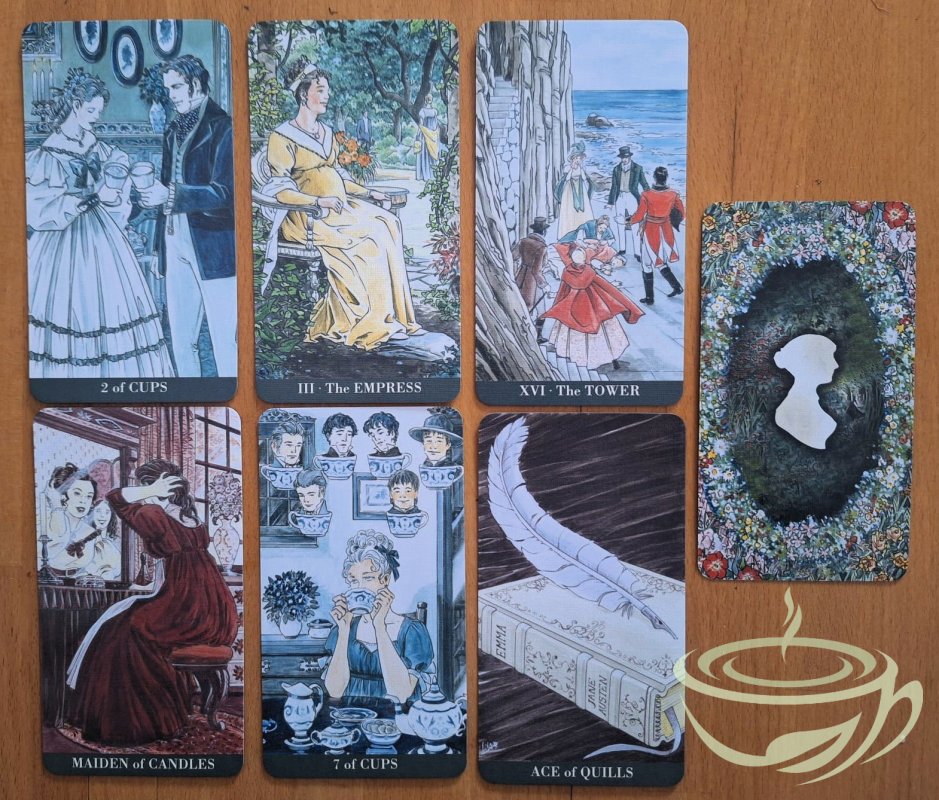
For many years, this Jane Austen Tarot was out of print. Other authors and illustrators produced different versions, but this is probably the most popular Jane Austen Tarot. Diane Wilkes, who created it, is both a well-respected authority on tarot (her website, Tarot Passages, is well-known, and even though it hasn’t been updated for some time, it’s still a valuable resource) and a knowledgeable Austenite. Her unique skill set allowed her to conceive the tarot archetypes in Jane Austen’s world, and Lo Scarabeo produced the deck. 


The Italian graphic artist Lola Airaghi illustrated the deck, and this combination of an author and an illustrator is typical for many Lo Scarabeo decks. In an interview with April Lindner, Diane Wilkes talked about the work process. Since Airaghi was not familiar with Jane Austen’s books, Diane sent her detailed explanations and also links to clips of movie adaptations.


If you are familiar with these adaptations, you’ll recognise the influence of Adrian’s famously sumptuous but anachronistic costumes for the 1940 version with Greer Garson and Laurence Olivier. Instead of the high-waisted Regency costumes, Adrian decided to go for the lower waist, full sleeves and voluminous gowns in the fashion of the 1830s. And that’s what you see on some of the cards.


It doesn’t detract from the charm of the cards, but from a costume buff’s perspective, it’s a bit confusing to see 1813’s Regency dresses on one card and 1830’s butterfly silhouette on the next.


You can see the influence of the 1996 version of Emma (with Gwyneth Paltrow) in some of the cards – especially in the Sun and the World. Mr Dashwood’s deathbed scene in the Death card reminds me very much of the film version (1995 with Emma Thompson).


Some of Airaghi’s faces look very modern, and sometimes, her style is too cartoonish for my personal taste. Lo Scarabeo has worked over the years with many cartoon and comic artists, and while they are competent and skilled, they don’t always convey the magical or introspective character of the tarot. I love the settings of the cards – the houses, rooms and garden, but I don’t like all the figures as much. However, that’s a minor quibble because overall, the marriage of Jane Austen and the tarot works well (and is an Austenite tarotist’s dream!).


While on some cards, the facial expressions are a bit exaggerated, on others, they are just right and bring the scene to life. Overall, I find the serious cards more successful than the smiling or excited faces. However, that's only my personal taste. Overall, the ink-and-watercolour illustrations are expressive, clear and well-composed. 


The deck was first released in 2007, and from older reviews of the deck, it seems that it was accompanied by a more substantial book than the new version. I have the new edition that comes with a small booklet, unillustrated, in English and Italian. It gives you the scene and connects it to the meaning of the tarot card without going very deep. However, if you know Jane Austen, that’s enough to get you going. Wilkes doesn’t only focus on Pride and Prejudice, Austen’s most popular book. You will also find scenes from the other books, and that’s definitely a bonus. Even Lady Susan makes an appearance – aptly enough, she represents the Devil.


The new edition of the deck that was released in 2026 for Jane Austen’s 250th birthday anniversary has non-reversible card backs, as opposed to the old version, which is a pity, but Lo Scarabeo decided to let go of the notorious multi-language card names on the borders, and that’s a very good decision. The cards are now borderless, with a dark green area at the bottom giving the card number and titles in a clear, off-white font.


The Majors are colourful, and the minor suits are colour-coded. The Candles suit (Wands) is mostly in warm red, orange,  yellow and brown. The Cups are teal, the Quills (Swords) grey, and the Coins in earth colours like green and brown. The colouring helps to set the scene for each suit and unifies them visually. However, some of the cards look a bit drab, especially in the Coins suit.


The card choices are intelligent and illuminating. I find Wilkes’ choices for the court cards especially interesting. The Maiden of Candles is Lydia Bennet, the Lady of Candles is Elizabeth Bennet, and the Lord of Candles is Captain Wentworth. Diane Wilkes goes along with the tarot archetypes and doesn’t pair them according to the books, and that is the right choice.


Susan Price makes an appearance in the 2 of Candles, looking at her silver knife, planning how to gain it back. Her anger and struggle haven’t helped her, but gentle Fanny, standing behind her, will help her reach her goal. There are not only two candles in this card, but also two sisters who complement each other. This is a surprising choice, but it works well.


In the 4 of Coins, greedy Fanny Dashwood counts her money. Her husband sits next to her with a worried, defeated face, and in the background, we see Mrs Dashwood with Elinor and Marianne in the shadows. Clearly, they can’t expect any generosity from the heir of the Dashwood estate. This is a more obvious choice, referring to the grasping aspect of the card. By stabilising their fortune, the stingy couple take away all stability from their half-sisters and stepmother. (This is another scene that reminds me very much of the Emma Thompson version of Sense and Sensibility, with Mrs Dashwood’s huge widow’s cap).


I wish the 140-page original book were republished as well; that would make the new version perfect. From what I read online, I understand that there was a chapter “What would Jane do?”, and that sounds wonderful. I don’t know why they cut down the book to the bare bones.


If you want to buy a Jane Austen Tarot and are hesitating between this version and Jacqui Oakley’s Jane Austen Tarot, go for this one. It does justice to Jane Austen AND the tarot. 


×
×
  • Create New...

Important Information

We have placed cookies on your device to help make this website better. You can adjust your cookie settings, otherwise we'll assume you're okay to continue.