
A New Deck: The Alchemical Tarot

Entry posted by Kluizenaar in Meta
1,256 views
I bought a new tarot deck, and it was well overdue. I was feeling burnt out on the jumble of symbolic systems found in The Hermetic Tarot, and the imagery of the Rider-Waite-Smith decks and their numerous copies had become stale. On the other hand, I encountered many decks online that didn't resonate with me at all; their symbolism was minimal, and the distinctions between the cards were vague. This left me feeling disheartened, but I must admit that I hadn’t been searching thoroughly enough.
I have two main criteria for a tarot deck, and it must meet at least one of them:
- 1. The visual language must appeal to me aesthetically.
- 2. The meaning system must be structured and intellectually stimulating.
 Therefore, it was a breath of fresh air to discover that Robert M. Place's The Alchemical Tarot meets both of these criteria: it is both beautiful and complex. Additionally, it features a theme that has captivated me for years and that I regularly explore: alchemy. I find the idea that material 'reality' can be equated with—or at least serve as a metaphor for—a spiritual truth absolutely fascinating. This aligns with the Hermetic principle "as above, so below," a concept I hold dear.
The deck showcases artwork that appears quite old-fashioned, as if it belongs to a bygone era. The color palette is calm and harmonious; all the cards are similar enough to blend seamlessly together, yet they possess distinct differences that make them easy to distinguish. However, I don’t want this to read as a promotional piece, nor do I intend to write a formal review.
I prefer to delve into the alchemical principles embodied in this deck. First, there are the four suits: Coins, Vessels, Swords, and Staffs, which represent the alchemical elements of Earth, Water, Air, and Fire, and also correspond to Jung's proposed psychological functions. The Vessels represent intuition, emphasizing possibilities and deeper meanings. The Coins are associated with feeling, focusing on values and emotions in relationships. The Swords align with thinking, prioritizing logic and analysis in decision-making. Finally, the Staffs relate to sensation, grounding individuals in the present and emphasizing tangible experiences. Together, these suits provide a holistic approach to tarot readings, facilitating self-discovery and personal growth by integrating various aspects of the psyche. This deck thus combines medieval alchemical views with modern psychological insights.
The major arcana beautifully reflect the alchemist's Magnum Opus, or the search for the Philosopher's Stone. It's not a gradual, perfect progression but a journey filled with ups and downs, illustrating that some experiments may fail, falter, or get abandoned—and that’s perfectly okay; that’s life. Concepts like Nigredo (the stage of blackening or decomposition), Albedo (the stage of whitening or purification), Citrinization (the stage of yellowing or enlightenment), and Rubedo (the stage of reddening or completion) are present, along with the underlying processes of distillation and purification. In some cases, these are represented by glyphs, but there are also more metaphorical images such as the Green Lion (Strength) and the Grey Wolf (Nine of Staffs).
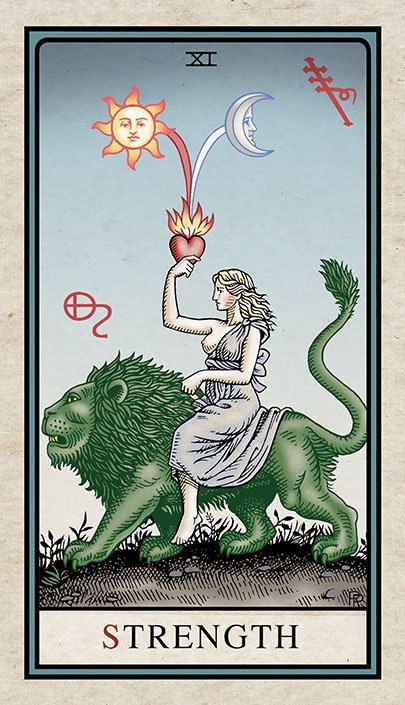 The Green Lion symbolizes the raw, untamed forces of transformation, representing the initial breakdown of materials in the alchemical process. In contrast, the Grey Wolf embodies loyalty and instinct, signifying the journey through the darker aspects of the self. Together, they reflect the balance between primal potential and intuitive guidance in the alchemical journey.
The deck also features the colors red and white quite prominently in many cards. White is associated with mercury, symbolizing the fluid, receptive aspects of transformation and the unifying force of intellect. Conversely, red represents sulfur, which embodies the active, fiery principle of transformation and the spirit's passion. This interplay between red sulfur and white mercury illustrates the dynamic balance needed for true alchemical transformation, merging spirit and matter on the path to enlightenment.
In summary, The Alchemical Tarot connects alchemical concepts with psychological insights, offering a unique lens through which to explore personal transformation. Its rich imagery and symbolism encourage reflection on the processes of change and self-discovery. Engaging with this deck allows individuals to navigate their journeys, blending ancient wisdom with contemporary understanding as they seek to harmonize the various aspects of their lives. Having already begun to work with it, I am curious to see what this deck will reveal to me as I continue my exploration.
Edited by Kluizenaar
6 Comments
Recommended Comments