Jump to content

Golden Tarot of Klimt


Creator: Pietro Alliga

Artist: A.A. Atanassov

ISBN-10 :  0738707902

ISBN-13 :  978-0738707907

First Published: June 2005

Book pages: 63 (14 in English, the others in Italian, Spanish, French, and German)

Card #: 78

Card size: 2.75 x 1.13 x 4.88 inches; 11.5x6.5 cm

Cardstock:  thin, matte, gold-foil stampings

Box: simple tuck box

Language: English (multi-language LWB)

Publisher: Lo Scarabeo; Llewellyn Publications (US), 2005

Purchase here: LoscarabeoAmazon UKAmazon US, available in most mass market shops.

Different Deck Versions: There are different versions of the same deck and also different names. Some boxes have the Golden Tarot of Klimt but some, Klimt Tarot. There is a deluxe version of the Golden Tarot with a gold Klimt bag, this is now OOP. There is also a mini tarot (card size 1.7" x 3.1"), published in 2015 called "Klimt Tarot: Pocket Golden Edition"


From the album:

Artistic Decks

· 47 images
  • 47 images

Photo Information


Nemia


Golden Tarot of Klimt


Changes in majors: traditional card names

Suit names: Wands, Chalices, Swords, Wands

Court cards: Knave, Knight, Queen, King

Card backs: fully reversible

Extra cards: -


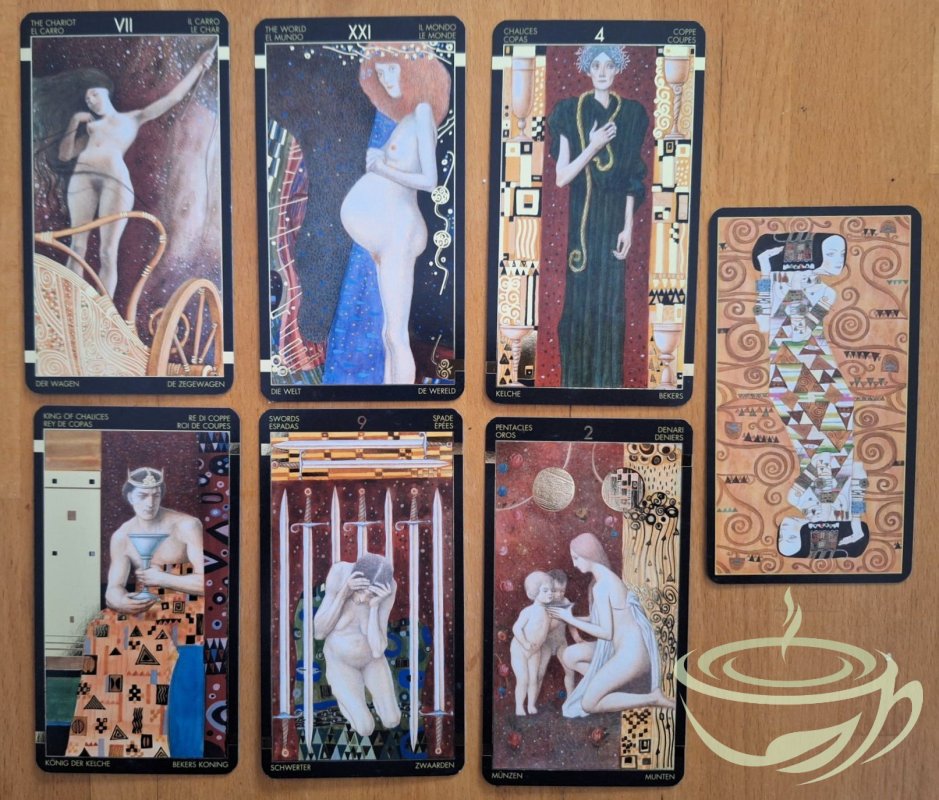
The Golden Tarot of Klimt has been on the market for many years, and it is one of the decks Lo Scarabeo commissioned from the artist Atanas A. Atanassov. Considering the large number of decks Atanassov has illustrated over the years, it’s astonishing to find little to no information about him on the Internet. Since different authors are mentioned by Scarabeo, it seems that Atanassov worked from a script by Lo Scarabeo tarot experts, and “translated” them into the visual language of popular artists like Klimt, Botticelli, Leonardo da Vinci and others. One of the most successful and well-known of these decks is the Golden Tarot of Klimt.


While the simple tuckbox and the multi-lingual, short LWB show their age (we expect much fancier productions nowadays), the cards themselves look sumptuous, thanks to the black backgrounds and gold stampings.  The images are set in a thin golden frame and surrounded by a black border, with the card titles in different languages in all four corners in small, golden-yellow uppercase letters. The numerals (Roman for the Majors, Arabic for the Minors) are set at the top of the card in gold foil.


There is gold detailing also on the borders, which looks stunning when you fan out the deck. It looks like golden bands connect the cards, a beautiful effect.


Atanassov’s skill in recreating different artistic styles is quite amazing. As opposed to newer decks that use digital collage to create decks in specific artistic styles, Atanassov’s cards are hand-drawn. Judging from the relatively small cards, he used coloured pencils for the figures and probably gouache for the backgrounds. Each artistic medium works differently, so it’s remarkable that Atanassov could get so close to Gustav Klimt’s oil paintings using different media.


Klimt is one of the most popular artists of the late 19th and early 20th century and is sometimes seen as the epitome of the Viennese fin de siècle spirit, the age of one era and the beginning of another. Women feature prominently in his most popular works, often as sensuous temptresses, but he was also a wonderful landscape artist, portraitist and designer. You can see one his landscapes on the 10 of Pentacles. He used decorative, mosaic-like patterns in his art, and often inserted golden elements that were inspired by Byzantine art.


The patterned areas, golden lines and abstract elements flatten the picture plane, but the figures are painted three-dimensionally with careful graduations of flesh tones. The inherent tension between these flat, abstract, decorative planes and the rounded figures gives Klimt’s art and this deck an otherworldly feeling, again a bit like in Byzantine art where the figures seem to float in abstract spaces.


It’s a pity that the booklet doesn’t provide us with the inspirations for each card, but Benebell Wen’s review of the deck includes a list of the paintings she found, so I won’t repeat her research here.


While this deck looks strikingly different to the RWS, you can read with it right out of the box if you know the RWS system. Some cards, like the Fool, don’t show the innocence and daring that we know from the RWS Fool, but instead a figure of confusion and near madness. However, like the RWS Fool, he doesn’t know where he is going.


This is not an RWS “clone”, but even where the iconography is quite different, the core meanings of the RWS will help you decipher the meaning of the card.


The Hierophant is Klimt himself, looking out of his self-portrait, wearing one of his infamous smocks, decorated beautifully.


Klimt was famous (even notorious) for the erotic content of his art, so you can’t be surprised that many cards have an element of eroticism as well, and some cards show full frontal nudity. If that bothers you, this deck is not for you, and if you know that your querents won’t like it, I wouldn’t recommend doing public readings with it. Personally, I’m not bothered by it at all, and a modest Klimt deck wouldn’t be Klimt after all.


I bought my deck second-hand many years ago and have used it regularly. It has held up very well; the black borders haven’t become scuffed, and the gold foil is still pristine and shiny. It’s a stunning deck that works especially well for love readings, but also shadow work. The depiction of negative emotions is unflinching and honest, and the faces and body language of the figures are expressive and echo with me whenever I look at them.


Lo Scarabeo has since ditched the multi-lingual titles, and if they should ever release a new edition of this deck with a more substantive book, I think many people would love it.


×
×
  • Create New...

Important Information

We have placed cookies on your device to help make this website better. You can adjust your cookie settings, otherwise we'll assume you're okay to continue.