Jump to content


  • Image Reviews

      Tarot of the Secret Forest
       
       
      Changes in majors: traditional names
      Suit names: Wands, Chalices, Swords, Pentacles
      Court cards: Knave, Knight, Queen, King
      Card backs: black-and-white drawing of the card image, not reversible
       
      There are many decks that depict the forest – a beloved metaphor of the soul and its secrets, of life’s journey with its challenges and surprises, and the place untouched by the cultivating hand of humans. Fairies, gnomes and mythological beasts live there, Hansel and Gretel got lost there, and in many cultures, the forest is the wild, untamed paradise that we long to go back to. Simon Schama writes beautifully about the forest as a national origin myth in “Landscape and Memory”, if anyone is interested in that topic.
       
      However, while there is no lack of tarot decks depicting the forest, the Tarot of the Secret Forest is unique in its blend of the natural and supernatural world. Other decks show the forest as an idyllic, enchanting place where you always feel safe. Some of these decks, beautiful as they are, present the forest like a public garden where you walk through and look around, enjoying the beauty but never feeling lost or confused.
       
      Lucia Mattioli, the artist of the Secret Forest Tarot, lives next to a wild forest, and this is what she paints. There are brambles, insects (yes, also spiders, not my favourite animal), and the fairy creatures we encounter when we follow her are neither cute nor inviting. It feels as though they’d rather be left alone. We are strangers in that forest, and we have to respect this wild world that we have left behind us when we started to build houses and cities.  
       
      There are many painted forests that you leave with clean hands and feet, but in the Secret Forest, you’ll get spiderwebs in your hair, dirt on your feet and knees, and scratches on your arms and legs. Lots of brambles, and the few traces of human habitation look as though they have been left ages ago.
       
      In the Six of Chalices for example, a dog sits in front of a half-open garden gate, but the garden looks wild. Nature has taken it back. In the Seven of Wands, lizards crawl on a sarcophagus-shaped stone that must have been sculpted centuries ago. It all feels a bit like Frodo and Sam in the Mirkwood.
       
      I love Mattioli’s art style. She works with oil colours and builds them up to a thick impasto, giving her pictures a three-dimensional, tactile quality. Even in the reproductions, you feel that build-up of colour, and it gives the deck a strong sense of atmosphere. Not everybody may like it, but I find it very evocative.
       
      The colours are murky, muddy and earthy, with some highlights, but most scenes appear to take place in the dense shadows of a wild, uncultivated forest. Your eyes have to get used to this colour scheme, just like they have to get used to the uncertain light conditions when you walk through a dense forest. Some areas will be dappled with light, but others will feel really dark.
       
      The black  borders, with a lighter, thin inner corner, frame these beautiful images very well. (Not everybody will call them beautiful, but I certainly do; I love landscape paintings and Mattioli takes the forest seriously). There are smudges of colour on the top and bottom of the frames: yellowish for the Majors and Coins, red for the Wands, blue-greenish for the Chalices, and grey for the Swords. Over these colour spots, the card numbers and suit symbols are printed. There is not one written word on the cards; even the court cards are represented by easily identifiable symbols. Even the font is rough, as though painted with a thin brush and oil colours.
       
      The special touch is found on the backs of the cards. The artist has re-created the scene on the card in a black-and-white ink drawing. These are not simply reproductions of the card image but new works of art that focus on the main motif. These card backs have the same black borders and numbers, but without any colours. The images look even starker and bolder in black-and-white.
       
      This is the most non-reversible way of presenting a tarot deck I have ever seen, and it might irritate some users. I personally never saw a problem in non-reversible card backs – all you have to do is close your eyes or simply not look at the cards, and that’s it. However, this deck really turns the non-reversible into a unique characteristic because you actually have two decks to work with.
       
      You can switch between the fronts and backs when doing a reading, or you can simply disregard the backs.
       
      Another way of incorporating these double-image cards would be by shuffling them wildly, mixing up the coloured and b/w sides, and reading them differently. The b/w images can represent the shadow side of the card.
       
      Lucia Mattioli’s second deck, the Fairy Lights Tarot, is much more upbeat, has simple card backs and uses a much livelier colour palette. I like it as well, but I prefer the Tarot of the Secret Forest for its earthy honesty and ability to see the magic of untamed nature, even where it’s frightening or strange, or the brambles scratch your ankles. And the fairies have a life of their own. They don’t wait for us. Some don’t notice us, others are busy, and those who welcome us, like the Page of Cups, may have sinister purposes. The Page of Swords even seems threatening.
       
      This deck reads well for me, especially for uncomfortable topics, self-reflection or thorny relationship issues. When you find yourself in a place in life where you’re not sure how to go on, when you tread carefully because you don’t know what’s going to crawl, fly or jump at you next, this deck will give you an idea how to go on.
       
      The LWB won't give you much to work with, but if you like this deck, your intuition will kick in strongly, and the basic RWS meanings will also help you with this deck. 
       
      Jane Austen Tarot
       
      Changes in majors: traditional names (XIII Strength, XI Justice)
      Suit names: Candles (Wands), Cups, Quills (Swords), Coins (Pentacles)
      Court cards: Maiden, Knight, Lady, Lord
      Card backs:  not reversible (flower wreath with profile portrait of Jane Austen)
      Extra cards: -
       
      For many years, this Jane Austen Tarot was out of print. Other authors and illustrators produced different versions, but this is probably the most popular Jane Austen Tarot. Diane Wilkes, who created it, is both a well-respected authority on tarot (her website, Tarot Passages, is well-known, and even though it hasn’t been updated for some time, it’s still a valuable resource) and a knowledgeable Austenite. Her unique skill set allowed her to conceive the tarot archetypes in Jane Austen’s world, and Lo Scarabeo produced the deck. 
       
      The Italian graphic artist Lola Airaghi illustrated the deck, and this combination of an author and an illustrator is typical for many Lo Scarabeo decks. In an interview with April Lindner, Diane Wilkes talked about the work process. Since Airaghi was not familiar with Jane Austen’s books, Diane sent her detailed explanations and also links to clips of movie adaptations.
       
      If you are familiar with these adaptations, you’ll recognise the influence of Adrian’s famously sumptuous but anachronistic costumes for the 1940 version with Greer Garson and Laurence Olivier. Instead of the high-waisted Regency costumes, Adrian decided to go for the lower waist, full sleeves and voluminous gowns in the fashion of the 1830s. And that’s what you see on some of the cards.
       
      It doesn’t detract from the charm of the cards, but from a costume buff’s perspective, it’s a bit confusing to see 1813’s Regency dresses on one card and 1830’s butterfly silhouette on the next.
       
      You can see the influence of the 1996 version of Emma (with Gwyneth Paltrow) in some of the cards – especially in the Sun and the World. Mr Dashwood’s deathbed scene in the Death card reminds me very much of the film version (1995 with Emma Thompson).
       
      Some of Airaghi’s faces look very modern, and sometimes, her style is too cartoonish for my personal taste. Lo Scarabeo has worked over the years with many cartoon and comic artists, and while they are competent and skilled, they don’t always convey the magical or introspective character of the tarot. I love the settings of the cards – the houses, rooms and garden, but I don’t like all the figures as much. However, that’s a minor quibble because overall, the marriage of Jane Austen and the tarot works well (and is an Austenite tarotist’s dream!).
       
      While on some cards, the facial expressions are a bit exaggerated, on others, they are just right and bring the scene to life. Overall, I find the serious cards more successful than the smiling or excited faces. However, that's only my personal taste. Overall, the ink-and-watercolour illustrations are expressive, clear and well-composed. 
       
      The deck was first released in 2007, and from older reviews of the deck, it seems that it was accompanied by a more substantial book than the new version. I have the new edition that comes with a small booklet, unillustrated, in English and Italian. It gives you the scene and connects it to the meaning of the tarot card without going very deep. However, if you know Jane Austen, that’s enough to get you going. Wilkes doesn’t only focus on Pride and Prejudice, Austen’s most popular book. You will also find scenes from the other books, and that’s definitely a bonus. Even Lady Susan makes an appearance – aptly enough, she represents the Devil.
       
      The new edition of the deck that was released in 2026 for Jane Austen’s 250th birthday anniversary has non-reversible card backs, as opposed to the old version, which is a pity, but Lo Scarabeo decided to let go of the notorious multi-language card names on the borders, and that’s a very good decision. The cards are now borderless, with a dark green area at the bottom giving the card number and titles in a clear, off-white font.
       
      The Majors are colourful, and the minor suits are colour-coded. The Candles suit (Wands) is mostly in warm red, orange,  yellow and brown. The Cups are teal, the Quills (Swords) grey, and the Coins in earth colours like green and brown. The colouring helps to set the scene for each suit and unifies them visually. However, some of the cards look a bit drab, especially in the Coins suit.
       
      The card choices are intelligent and illuminating. I find Wilkes’ choices for the court cards especially interesting. The Maiden of Candles is Lydia Bennet, the Lady of Candles is Elizabeth Bennet, and the Lord of Candles is Captain Wentworth. Diane Wilkes goes along with the tarot archetypes and doesn’t pair them according to the books, and that is the right choice.
       
      Susan Price makes an appearance in the 2 of Candles, looking at her silver knife, planning how to gain it back. Her anger and struggle haven’t helped her, but gentle Fanny, standing behind her, will help her reach her goal. There are not only two candles in this card, but also two sisters who complement each other. This is a surprising choice, but it works well.
       
      In the 4 of Coins, greedy Fanny Dashwood counts her money. Her husband sits next to her with a worried, defeated face, and in the background, we see Mrs Dashwood with Elinor and Marianne in the shadows. Clearly, they can’t expect any generosity from the heir of the Dashwood estate. This is a more obvious choice, referring to the grasping aspect of the card. By stabilising their fortune, the stingy couple take away all stability from their half-sisters and stepmother. (This is another scene that reminds me very much of the Emma Thompson version of Sense and Sensibility, with Mrs Dashwood’s huge widow’s cap).
       
      I wish the 140-page original book were republished as well; that would make the new version perfect. From what I read online, I understand that there was a chapter “What would Jane do?”, and that sounds wonderful. I don’t know why they cut down the book to the bare bones.
       
      If you want to buy a Jane Austen Tarot and are hesitating between this version and Jacqui Oakley’s Jane Austen Tarot, go for this one. It does justice to Jane Austen AND the tarot. 
       
      Golden Tarot of Klimt
       
      Changes in majors: traditional card names
      Suit names: Wands, Chalices, Swords, Wands
      Court cards: Knave, Knight, Queen, King
      Card backs: fully reversible
      Extra cards: -
       
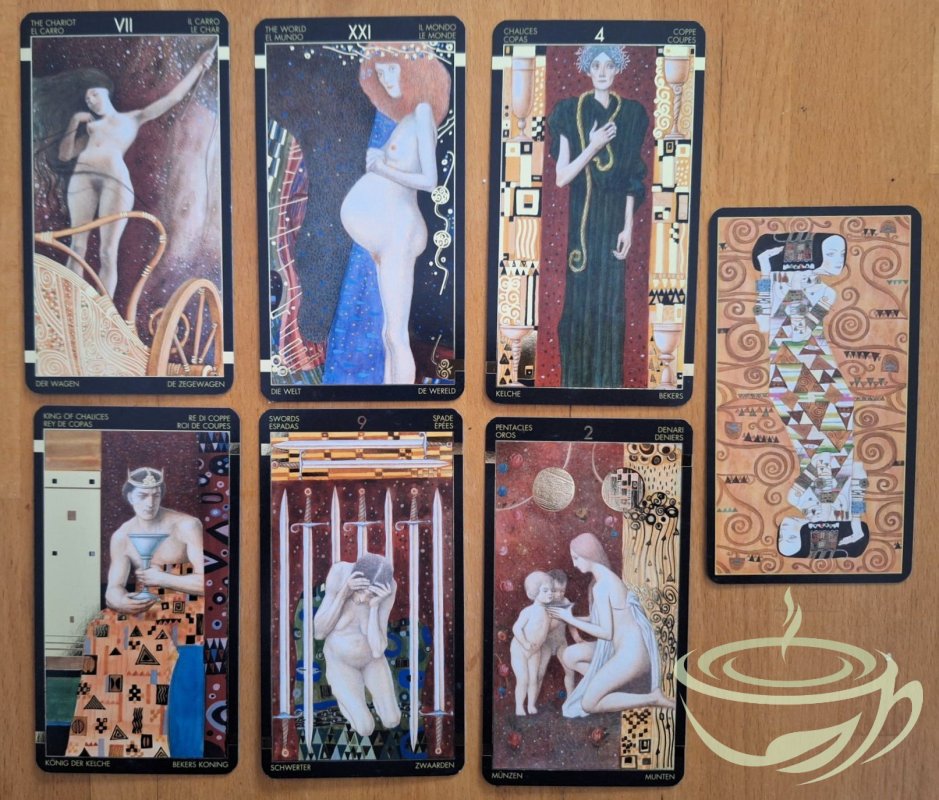
      The Golden Tarot of Klimt has been on the market for many years, and it is one of the decks Lo Scarabeo commissioned from the artist Atanas A. Atanassov. Considering the large number of decks Atanassov has illustrated over the years, it’s astonishing to find little to no information about him on the Internet. Since different authors are mentioned by Scarabeo, it seems that Atanassov worked from a script by Lo Scarabeo tarot experts, and “translated” them into the visual language of popular artists like Klimt, Botticelli, Leonardo da Vinci and others. One of the most successful and well-known of these decks is the Golden Tarot of Klimt.
       
      While the simple tuckbox and the multi-lingual, short LWB show their age (we expect much fancier productions nowadays), the cards themselves look sumptuous, thanks to the black backgrounds and gold stampings.  The images are set in a thin golden frame and surrounded by a black border, with the card titles in different languages in all four corners in small, golden-yellow uppercase letters. The numerals (Roman for the Majors, Arabic for the Minors) are set at the top of the card in gold foil.
       
      There is gold detailing also on the borders, which looks stunning when you fan out the deck. It looks like golden bands connect the cards, a beautiful effect.
       
      Atanassov’s skill in recreating different artistic styles is quite amazing. As opposed to newer decks that use digital collage to create decks in specific artistic styles, Atanassov’s cards are hand-drawn. Judging from the relatively small cards, he used coloured pencils for the figures and probably gouache for the backgrounds. Each artistic medium works differently, so it’s remarkable that Atanassov could get so close to Gustav Klimt’s oil paintings using different media.
       
      Klimt is one of the most popular artists of the late 19th and early 20th century and is sometimes seen as the epitome of the Viennese fin de siècle spirit, the age of one era and the beginning of another. Women feature prominently in his most popular works, often as sensuous temptresses, but he was also a wonderful landscape artist, portraitist and designer. You can see one his landscapes on the 10 of Pentacles. He used decorative, mosaic-like patterns in his art, and often inserted golden elements that were inspired by Byzantine art.
       
      The patterned areas, golden lines and abstract elements flatten the picture plane, but the figures are painted three-dimensionally with careful graduations of flesh tones. The inherent tension between these flat, abstract, decorative planes and the rounded figures gives Klimt’s art and this deck an otherworldly feeling, again a bit like in Byzantine art where the figures seem to float in abstract spaces.
       
      It’s a pity that the booklet doesn’t provide us with the inspirations for each card, but Benebell Wen’s review of the deck includes a list of the paintings she found, so I won’t repeat her research here.
       
      While this deck looks strikingly different to the RWS, you can read with it right out of the box if you know the RWS system. Some cards, like the Fool, don’t show the innocence and daring that we know from the RWS Fool, but instead a figure of confusion and near madness. However, like the RWS Fool, he doesn’t know where he is going.
       
      This is not an RWS “clone”, but even where the iconography is quite different, the core meanings of the RWS will help you decipher the meaning of the card.
       
      The Hierophant is Klimt himself, looking out of his self-portrait, wearing one of his infamous smocks, decorated beautifully.
       
      Klimt was famous (even notorious) for the erotic content of his art, so you can’t be surprised that many cards have an element of eroticism as well, and some cards show full frontal nudity. If that bothers you, this deck is not for you, and if you know that your querents won’t like it, I wouldn’t recommend doing public readings with it. Personally, I’m not bothered by it at all, and a modest Klimt deck wouldn’t be Klimt after all.
       
      I bought my deck second-hand many years ago and have used it regularly. It has held up very well; the black borders haven’t become scuffed, and the gold foil is still pristine and shiny. It’s a stunning deck that works especially well for love readings, but also shadow work. The depiction of negative emotions is unflinching and honest, and the faces and body language of the figures are expressive and echo with me whenever I look at them.
       
      Lo Scarabeo has since ditched the multi-lingual titles, and if they should ever release a new edition of this deck with a more substantive book, I think many people would love it.
       
      Verdance Tarot
       
      Changes in majors: mostly traditional names (II Magus instead of Magician)
      Suit names: Wands, Cups, Swords, Coins
      Court cards: Page, Knight, Queen, King
      Card backs: fully reversible
      Cardstock: thin, matte, flexible
      Extra cards: two information cards (about the artist and her earlier deck, the Shadowscapes Tarot)
      Additions: a simple, sturdy carton card stand for one card, dark blue with a half-moon symbol
       
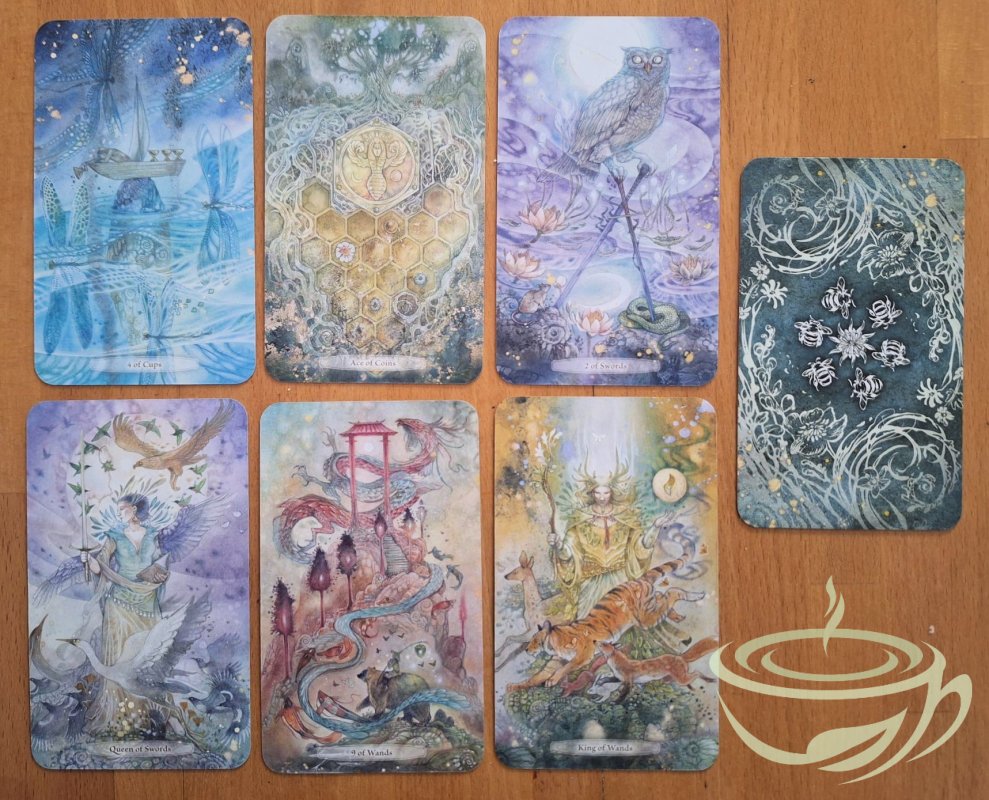
      The Verdance Tarot is a stunningly beautiful deck with an interesting name. It combines the lushness and abundance of the verdant world with the flow and movement of dance, not only in its name but in every card.
       
      Stephanie Pui Mun-Law’s first deck, the Shadowscapes Tarot, has been praised for its gorgeous art and atmosphere of magic. Could we imagine that this artist has developed and grown to become even better? No, but she has done it. The only point of critique frequently mentioned about the Shadowscapes Tarot is its size – it’s a bit too small to see the exquisite details properly, and while its silvery-lavender borders are beautiful, they take up valuable space on the cards.
       
      The Verdance Tarot is borderless, and the card names are inserted into small, transparent banners at the bottom of the cards. The card names and numbers are set in a small, brown font that doesn’t disturb the atmosphere at all. Laid out next to each other, the cards merge into a rich tapestry. When we look at this world, we seem to acquire a new set of eyes, allowing us to see more than we usually do, to see deeper, to get a glimpse of the truth behind the beauty.
       
      Most of the deck’s protagonists are animals. The few human figures are not actually humans but fairies or nature spirits, and very few look at us and notice us (like the Nine of Coins). The Knights ride on mythological animals, and the Kings and Queens contemplate the world they are ruling. All these wonderful creatures are shown in their world and reveal it to us.
       
      Mythological creatures like the unicorn, hippogriff and phoenix blend seamlessly with the warbler, maple tree and blackbirds.
       
      The full-page, full-colour illustrations of the excellent book allow us to see the cards in detail, and they are extremely detailed. Wherever you focus your eye, more and more details appear. It reminds me a bit of fractals with their endless complexity.
       
      There is a lot of movement in these cards, but it’s never hasty or disruptive. It’s a serene, elegant movement in waves, spirals, arches and complex patterns.
       
      The book is a valuable addition to the deck. It lists the symbolic meanings of the animals and plants that appear in the deck, along with the cards on which these animals appear. The dragonfly, for example, stands for transformation and spiritual growth, and it shows up in no less than ten cards, from the High Priestess and Temperance to the 10 and Page of Cups. If you want to study this deck, I’d suggest you group together all the dragonfly cards, all the dandelion cards, or all the starfish cards, and see them as a whole. These motifs bind the deck together. Even without the book explanation, you can feel intuitively what these animals and plants want to tell you.
       
      The watercolour art of this deck is masterful and inspired. The compositions seem to have endless depth and complexity, and while the focus of each card is painted in a highly controlled and detailed manner, there are areas in each card where the artist has let the paint and water interact more freely. These are the areas I love especially.
       
      The colouring is rich, with translucent washes that unite the whole deck. Blues, greens, purples and yellows flow into each other. These are not card illustrations but visionary works of art, inspired by the tarot and inspiring to the reader.
       
      The book offers three spreads for this deck: the Inner Garden spread, the See the Forest for the Trees spread, and the Sacred Grove spread. This deck is ideal for meditation, deep personal insight, and gaining a new perspective on life. It’s not a beginner’s deck; I imagine a beginner would be overwhelmed by the richness of the art and the symbolic meanings of each detail, but if you know the tarot archetypes and love the magic of nature, this is a deck you won’t wish to miss. I keep mine in a piece of silk that I painted many years ago with purple hues, and some of the card backgrounds remind me of silk paintings.
      Fairy Tale Tarot by Lisa Hunt
       
      Creator: Lisa Hunt
      Artist: Lisa Hunt
      ISBN-10 ‏: ‎ 1646712137
      ISBN-13 ‏: ‎ 978-1646712137
      Book pages: 154
      Card #: 78
      Card size: 12x6.5 cm; 1.18 x 3.27 x 5.24 inches
      Card stock:  smooth, matte, flexible, no gilding, no gold foil, borderless
      Box: sturdy two-piece box
      Language: English
      Publisher: US Games, December 2024
      Purchase here:
       
      Changes in majors: some majors have been renamed, for example: 0 Innocence (Fool), II the Sorceress (High Priestess), III the Fairy Godmother (Empress), IV the Wise Old Man (Emperor), VIII Courage (Strength), V the Mentor (Hierophant), X the Wheel (Wheel of Fortune), XIII the Transformation (Death), XII Entrapment (Hanged Man), XV Temptation (Devil), XVI Deception (Tower)
      Suit names: Wands, Cups, Swords, Pentacles
      Court cards: Princess, Prince, Queen, King
      Card backs: fully reversible
       
      For many years, Lisa Hunt’s Fairy Tale Tarot was out of print, and it was only available for fantasy prices on the second-hand market. Its new release was long-awaited, and if you love Lisa Hunt’s art and especially her tarot art (as I do), and if fairy-tale themed decks speak to you (as they do to me), this is a dream fulfilment deck.
       
      Lisa Hunt’s detailed, highly skilled and strongly atmospheric watercolour art needs no introduction. She has produced a unique body of tarot decks over the years, and each of them reflects her deep understanding of the tarot archetypes by transporting them into different settings: the world of Ghosts and Spirits, or the past of the US countryside in the Pastoral Tarot.
       
      Both the tarot and fairy tales dive into the magical world of Jung’s collective unconscious, so it’s not difficult to understand why fairy tale tarot decks work so well.
       
      The booklet brings the tales and tarot archetypes together. For each card, it gives us the name of the story, the culture it came from, and some carefully chosen keywords. While the deck is multi-cultural and includes African, Scandinavian, Hindu, Serbian, Norwegian, Middle Eastern and Central Asian fairy tales, many cards are from the collection of the Brothers Grimm, i.e. German or Central European.
       
      Some of these fairy tales have been popularised by Disney movies, but many of the tales that inspired this deck are less well-known to non-Germans. Lisa Hunt goes back to the Grimm tales themselves, which is great because the pre-Disney versions are rougher, tougher and are strongly anchored in the popular culture before the Industrial Revolution. The same is true for Hans Christian Andersen’s poetic and melancholic fairy tales.
       
      As the tarot deals also with negative experiences and emotions, Hunt’s choice of original fairy tales is very apt. One of my favourite fairy tales from my childhood, the Goose Girl, appears as XI, Justice, and this resonates so strongly with me. These cards are not only beautiful, but they also have a lot of depth, and her choices reveal the core of the tarot archetype AND the fairy tale at the same time.
       
      The cards are borderless, and the card names appear in decorative banners at the bottom of the card without covering up important elements of the artwork. The Roman numerals of the Minors float in decorated round cartouches with scrollwork at the top of the cards.
       
      As always in Hunt’s arts, there are lots of details to discover. The faces are expressive, the backgrounds atmospheric, and when you know the fairy tale, you immediately recognise it.
       
      Since this deck follows the RWS system, you can simply use it as an RWS stand-in, but I recommend reading more about the fairy tales to discover how they found their way into this deck. This also means that for me, this deck is best used in smaller spreads or as single cards for meditation work or affirmation. It’s a very dense and meaningful deck.
       
      Like all fairy tale decks, it is an amazing tool for Inner Child readings and shadow work. Nowadays, we often forget that these were not children’s stories but tales that adults told each other, often while busy with manual work in the evenings or in the winter, when it was impossible to work outside. They all deal with challenges and struggles; there are often clear antagonists and real dangers, so there is nothing cute or sugar-coated about fairy tales. Just the opposite: they can be quite confronting. 
       
      I love this deck and find working with it very rewarding.
×
×
  • Create New...

Important Information

We have placed cookies on your device to help make this website better. You can adjust your cookie settings, otherwise we'll assume you're okay to continue.